


AP Psychology: How to get 7 points on the AAQ
After recently attending the Advanced Placement Summer Institute class with authors of the AP test and scorers of the 2025 AP Psychology test, I learned some key information about what scorers are looking for when they grade AP Psychology FRQs. This blog post will explain how to answer both an AAQ and an EBQ to ensure top marks on the AP test using one sample question from the Diogenes Education AP Psych course. First, we’ll show you the question for each type of FRQ (AAQ/EBQ), then we’ll give you tips and provide the solution that would earn the highest score.
How to answer the AP Psychology AAQ: the question
First, take a look below at this AAQ provided from this AP Psychology Unit 2 assessment:
Introduction
This study investigates whether the level of emotionally charged language in news headlines influences memory accuracy and belief in false information about real-world events.
Participants
A total of 120 undergraduate students from a midwestern university were recruited through a psychology subject pool and compensated with research credit. The final sample included 62% women and 38% men. Self-reported race/ethnicity was 60% White/European American, 18% Black/African American, 12% Hispanic/Latino/a, 7% Asian/Asian American, and 3% Other. Participants ranged in age from 18 to 34 years (M = 20.7, SD = 2.9). Researchers gave each participant a subject number to ensure that participants names were not published in the research paper.
Method
Participants read a one-page news article about a fictional protest event, followed by 5 minutes of arithmetic problems as a distractor task. Participants were randomly assigned to one of three headline conditions:
Low emotional language condition: Headline with zero emotionally-charged language (e.g., “Protest Draws Crowd in City Center”).
High emotional language condition: Headline with four emotionally-charged adjectives (e.g., “Angry Protest Dangerously Erupts in Chaotic Protest over Controversial Policy”).
Medium emotional language condition: Headline with two emotionally-charged adjectives (e.g., “Angry Protest Erupts Over Controversial Policy”).
Participants were then asked to complete a 40-item multiple-choice questionnaire about the article. Each item had two answer choices:
Correct: The accurate fact as stated in the article.
Incorrect: A completely unrelated or fabricated answer.
Results and Discussion
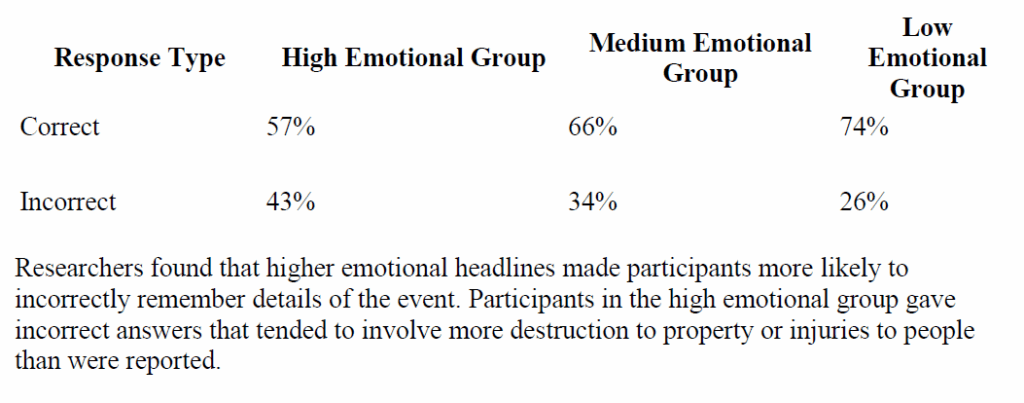
The table shows the average response rates for each group.
Mean Percentages of Correct and Incorrect Responses for Each Misinformation Condition
Adapted From:
Diogenes Education AP Psych Unit 2: Perception
Your response to the question should be provided in six parts: A, B, C, D, E and F. Write the response to each part of the question in complete sentences. Use appropriate psychological terminology in your response.
In the next section below, we’ll explain the answer that would earn 7 points on an AAQ:
The Correct Way to Answer An AAQ
In this next section, we’ll examine the optimal way to answer. Pay extra attention to the E section, but for now, the key thing to remember:The key thing to remember:
- Be consise: each part should be 1, maybe 2 sentence in length.
- Take the results at their word: don’t question the operational definitions validity, the methodology, etc. Just assume the study is 100% valid in your answers.
A. Identify the research method used in the study.
[it will be ONE of these five options: Case study, Experiment, Meta analysis, Observational Study, Correlation]
Example answer: The research method used was an experiment.
B. State the operational definition of high emotionally-charged language in the study.
[read carefully, as they will ask about either a dependent variable, independent variable, or operational definition, so make sure you answer the one they are asking about.] Example answer: The operational definition of high emotionally-charged language in this study was inclusion of 4 emotionally-charged adjectives in the headline.
C. Describe what the mean indicates for the percentage of correct responses between the high Emotional language group and the low emotional language group. Students must state the numbers:
[Here, pay attention to whether they ask for mean, median, or mode. Remember, your answer MUST state the numbers given in the results or else you won’t earn the points.] Example answer: The mean indicates that participants in the high emotional language group were less likely to answer correctly than those in the low emotional language group by 17 percent (57% correct in the high emotional group compared to 74% correct in the low emotional group). This suggests that increased emotional wording in headlines reduced memory accuracy for factual details in the article.
D. Identify at least one ethical guideline applied by the researchers.
[It’s going to be one of these five: International Review Board, Informed Consent (Withdrawal Rights are a part of informed consent), Confidentiality, No Harm, Debriefing]
Researchers ensured the confidentiality of their subjects.
E. Explain the extent to which the research findings may or may not be generalizable using specific and relevant evidence from the study.
[Either is correct but only do ONE:]
Because researchers took care to find varied demographics of participants, including ages 18-34, men and women, and multiple races, it is likely the results are highly generalizable.
[OR]
It is not generalizable because the data may skew slightly due to having a higher percentage of White women than the general population.
(BUT NOT BOTH! Choose one for your answer. While the Rubric states one can explain how it is both generalizable and not generalize if they provide evidence, but the test scorers advised NOT to do so. You will earn the point with either or these sample answers, but if you provide both you might lose the point!)
F. Explain how at least one of the research findings supports or refutes the misinformation effect.
[Formula: It refutes X because…. It doesn’t refute X because…It supports X because… it doesn’t support X because… students should write it exactly like this!]
Example answer: The findings of the experiment support the concept of the misinformation effect, in which information from a source can alter proper recollection of memories of an event.
Now you know how to get a 7 on the AAQ, but what about the EBQ? Let’s look at that next:
How to get 7 points on the EBQ
For this question, we’re using the FREE EBQ provided by Diogenes Education which you can download HERE from Unit 4: Social Psychology and Personality
Download the question, try and answer it yourself, and then look at the optimal answer below.
The Correct Way to Answer an EBQ

Remember this tip: Add two pieces of ICE (Introduce, Claim, Evidence).
Introduce: Mention the Psychological aspect that relates to the study (this is often in the beginning of the Claim as an unofficial category)
Claim: Provide a claim that can be derived from the studies.
Evidence: Provide evidence to support your claim.You just need to do this twice.
We answered this in a previous blog where you can check to see the optimal answer HERE.
How did your answer compare? Did you get it correct? If you need a Psychology lesson for your class:
Get Started with AP Psychology for 2024/2025
AP Psychology 2024/2025 full course bundle
AP Psychology AAQ Murder Mystery Practice
