


The New 2024 AP Psychology Test FRQs: AAQ and EBQ
Have you heard the news? AP Psychology just received one of the biggest changes to an AP Course ever. Yes, your students still need to know over 500 terms for the MCQ portion of the test, but, more importantly, students now need to be skilled in experimental design and analysis, including some basic statistics to answer the AAQs and EBQs (Article Analysis Questions and Evidence Based Questions). What type of questions should they be able to answer, and how can you prepare? First, download the new course guide from AP Central. Second, let’s take a look at a sample Free Response Question and examine the teaching strategies and knowledge you’ll have to impart to your students.
A sample Psychology AAQ Free Respons Question for 2024
If you need an EBQ, read here. For this AAQ, We’ll use a sample AAQ FRQ taken (with permission) from this AP Psychology course:
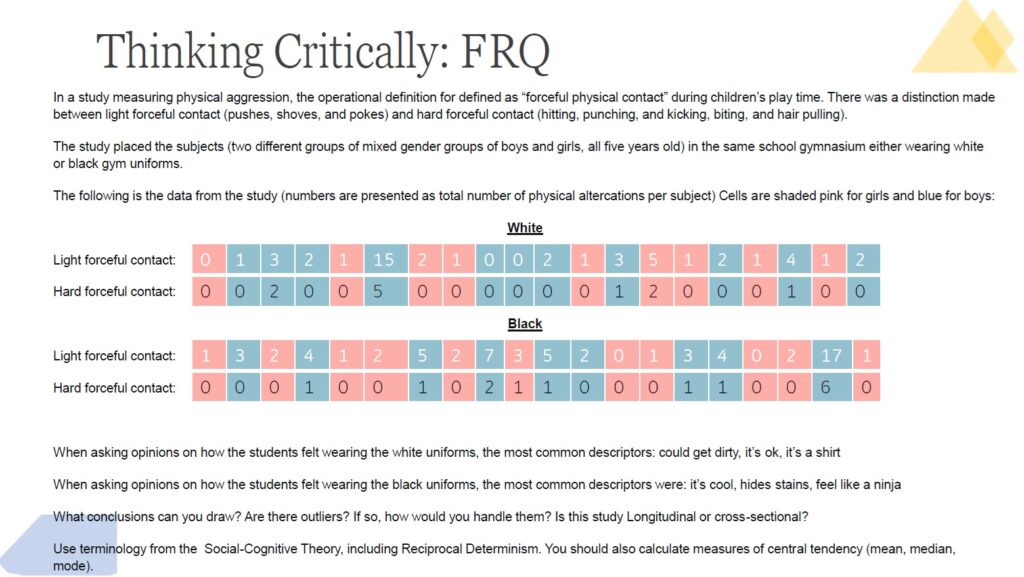
The question:
Introduction
This study aimed to examine how the color of children’s gym uniforms (white vs. black) might influence levels of physical aggression during playtime, with a hypothesis that the color of uniforms would have an effect on aggression. The researchers were interested in whether uniform color, as a situational environmental factor, would affect aggressive behaviors.
Participants
Two mixed-gender groups of 20 children (10 girls and 10 boys in each shirt-assigned group), all five-years old, participated. Gender differences were analyzed separately. Informed consent from parents was granted for each child. Permissino was granted by legal guardians before the study began, and both parents and children were told about the nature of the study and that the participating children were allowed to leave the study if they said they no longer wanted to play with the other children.
Method
Children were randomly assigned to wear either white or black gym uniforms and observed during a single thirty minute play session. Observers recorded instances of physical contact described as shoves/pushes/hits from one child to another. Physical aggression was defined as the total number of hard forceful contacts a subject made toward another subject (hitting, punching, kicking, biting, and hair pulling).
Results and Discussion
Quantitative results showed higher aggression in black uniforms Instances of contact in the group wearing white shirts:
Total: 11 physical contacts recorded /percentage of participants who engaged in
physical contact: 25%
Girls: 2 physical contacts recorded / percentage of participants who engaged in physical
contact: 10%
Boys: 9 physical contacts recorded / percentage of participants who engaged in
physical contact: 40%
Instances of contact in the group wearing black shirts:
Total: 13 physical contacts recorded / percentage of participants who engaged in
physical contact: 40%
Girls: 1 physical contacts recorded / percentage of participants who engaged in physical
contact: 10%
Boys: 14 physical contacts recorded / percentage of participants who engaged in
physical contact: 70%
White shirts
| G0 | B1 | B3 | B2 | G1 | B15 | G2 | G1 | B0 | B0 | B2 | G1 | B3 | G5 | G1 | B2 | G1 | B4 | G1 | B2 |
| G0 | B0 | B2 | B0 | G0 | B5 | G0 | G0 | B0 | B0 | B0 | G0 | B1 | G2 | G0 | B0 | G0 | B1 | G0 | B0 |
Black shirts
| G1 | B3 | G2 | B4 | G1 | G2 | B5 | G2 | B7 | G3 | B5 | B2 | G0 | G1 | B3 | B4 | G0 | G2 | B17 | G1 |
| G0 | B0 | G0 | B1 | G0 | G0 | B1 | G0 | B2 | G1 | B1 | B0 | G0 | G0 | B1 | B1 | G0 | G0 | B6 | G0 |
1. Identify the research method used in the study.
2. State the operational definition of Physical aggression.
3. Describe the meaning of the percentage of subejcts engaging in physical
hits by participants wearing black shirts compared to white shirts.
4. Identify at least one ethical guideline applied by the researchers.
5. Explain the extent to which the research finding may or may not be
generalizable using specific and relevant evidence from the study.
6. Explain how at least one of the research findings supports or refutes
the concept of reciprocal determinism in the study.
How to Analyze Psychology Free Response Questions: AAQ
Demographics: When looking at this question, the first thing students should pay attention to is the demographic information. The fact that the question has taken the time to differentiate data between boys and girls means the student should pay attention to this in their response. Students need to consider what type of sampling occurred (was this random sampling? Were students taken from a data pool of students who were already given time out for aggressive behavior? Was this a stratified random sample?). If a question mentions differences in age, gender, income, nationality, etc in the question, it is going to be an important part of the question to answer for generalizability.
Averages: Students need to know the basics of statistical analysis regarding measures of central tendency and what that indicates for results.
Operational Definitions: Students should be able to analyze if an operational definition is accurate and reliable. Does it measure what it is supposed to measure? This study measured “aggression” using the number of incidents of physical contact made, specifying “hard forceful contacts a subject made toward another subject (hitting, punching, kicking, biting, and hair pulling)”
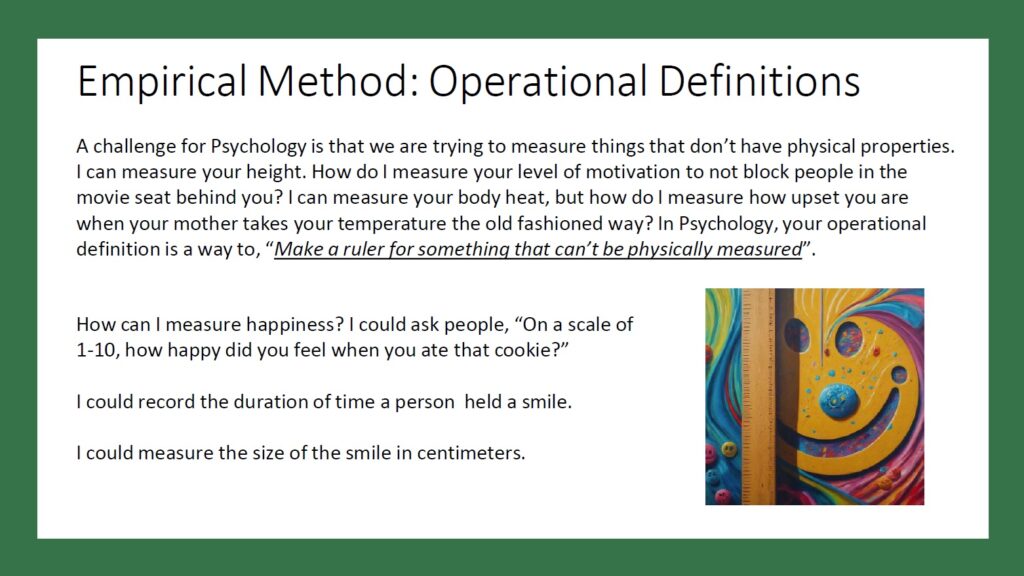
Types of Study: This question specifically asks the type of study from five options: observational, case study, correlational, experiment, meta-analysis. This is specifically an experiment because the study manipulated a variable.
Highlight and mark each question: This particular free response question is asking students to answer multiple things. Students are allowed to make marks on their test materials, so students should go through and highlight or underline each question and cross it out as they answer it to ensure they are not failing to answer any part of a question. Teach students to do this for each FRQ you assign.
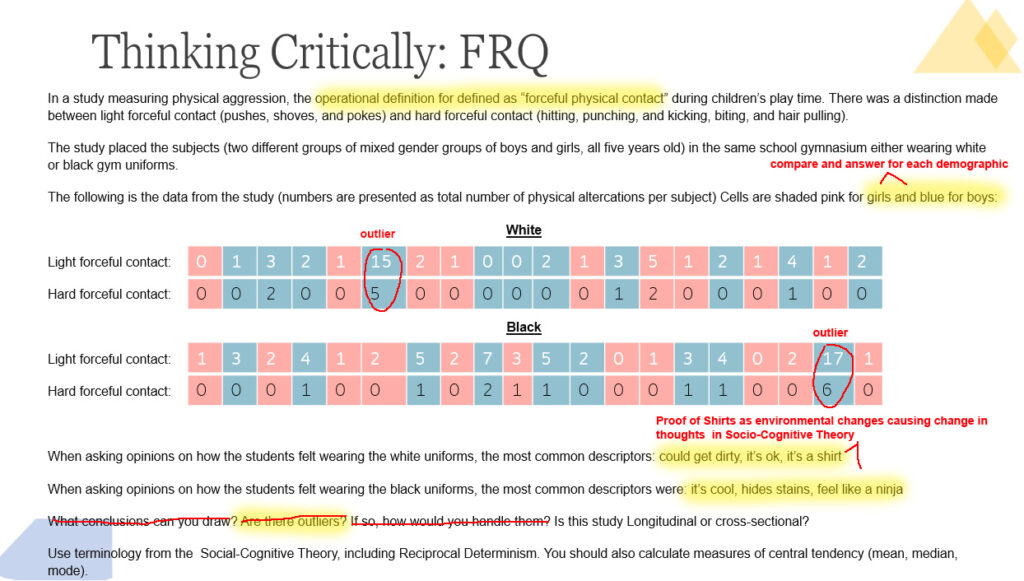
(Image taken from Diogenes AP Psychology Course 2024, used with permission)
Answering an AP Psychology 2024 Free Response Question AAQ
To find out how to answer this type of question, first read HOW IS THE AAQ SCORED? before going on to the next section!
Answer the AAQ using the RRSEGA format:

Research Method (1 Point)
This study was an experiment. Researchers controlled the independent variable (shirt color) while observing the dependent variable (physical aggression).
Research Variable (1 Point)
The operational definition of physical contact in this study was the number of incidents of hard forceful contacts a subject made toward another subject (hitting, punching, kicking, biting, and hair pulling)”
Statistic Interpretation (1 Point)
The study found that black uniforms increased physical aggression among boys
- Light aggression increased by 50.6% (from 1.68 incidents in white uniforms to 2.53 in black).
- Hard aggression increased by 31.25% (from 0.32 in white to 0.42 in black).
- Boys exhibited significantly higher levels of aggression in both categories:
- Light aggression (white: 1.9, black: 4.125) had a 117.1% increase
- Hard aggression (white: 0.4, black: 0.875) had a 118.75% increase
- Girls showed a slight decrease in aggression in black uniforms:
- Light aggression (white: 1.4, black: 1.34) had a 4.3% decrease
- Hard aggression (white: 0.22, black: 0.09) had a 59.1% decrease
We can conclude that this study shows girls have a slight decrease in both types of aggression in black, while boys have a 117.1% increase in light forceful contact and a 118.75% increase in hard physical aggression. Girls saw a decrease in light aggression by 4.3% and a decrease in hard aggression by 59.1%.
Ethical guidelines (1 point)
The study used a number of ethical guidelines. For the AAQ, choose just one and answer the ethical guideline used and what evidence the text provides that it was used. For example: An ethical guideline used was informed consent because children and parents “both parents and children were told about the nature of the study and that the participating children were allowed to leave the study if they said they no longer wanted to play with the other children.”
Generalizability (1 point)
The small sample size of the study (20 children in each group) means we can’t be sure the results will generalize to other children. Because of the age of the subjects (five years old), the results can not be generalized to adults or children of other ages.
Argument (1 point)
Environment can result in changes in the way people think, and thus changes in their behavior, known as reciprocal determinism. A change in the environment (the black-colored uniforms instead of white-uniforms) resulted in increased light physical aggression because it changed their thoughts, as indicated by their answers on the uniform descriptions.
Are your students ready?
After examining the answer, would the AP Psych students you taught last year have been able to answer the question as provided in the example here? If not, it’s time to start teaching for the new Free Response Questions by focusing on experimental design (demographics and samples, operational definitions and validity, types of studies) and statistical analysis (measures of central tendency and the strengths and weakness of mean, median, and mode). Teach students how to take notes on the FRQs so they don’t miss any parts of the question, and they can read between the lines, just like how the qualitative data about opinions on the shirts in the example above should be interpreted as clues for the environmental change leading to thought change and thus personality expression change according to the Reciprical Determinism theory of personality.
Focus on these aspects of experimental design and statistical analysis and prepare students to answer FRQs on the AP Psychology test. See this blog to learn how to score a perfect 7 on the AAQ. What should you expect for the EBQs? Take a look at a free sample EBQ from the Diogenes Education AP Psychology course here.
Get Started With the New Psychology Lessons in Your Classroom
AP Psychology Course | 2024 Psych Full Curriculum Bundle
AP Psychology AAQ Murder Mystery Practice Activity
AP Psychology EBQ Murder Mystery Practice Activity
